
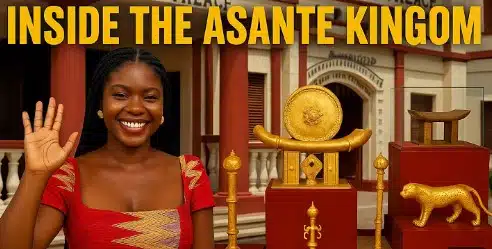
The Secrets of the MANHYIA PALACE: What You Can See and Experience
Stepping onto the grounds of the Manhyia Palace in Kumasi isn’t just a museum visit—it’s a spiritual homecoming. As an editor for ViewGhana, I’ve seen many landmarks, but there is an undeniable weight to the air here. It is the soul of the Asante Kingdom, a place where the past doesn’t just sit behind glass; it breathes.
If you are planning a visit, here is what you can expect to see and the secrets held within these historic walls.
1. The Homecoming: 32 Royal Treasures
The most electric part of the palace right now is the presence of the 32 royal artifacts recently returned from the British Museum and the V&A. After 120 years in exile, these items are finally home.
-
The Gold Sword of State (Mponponsuo): Used in royal rituals to symbolize authority.
-
Royal Regalia: Gold peace pipes, breastplates worn by soul-washers (Akra Kumu), and intricate gold jewelry.
-
The Significance: These aren’t just “objects”; they are the physical manifestation of Asante power and spiritual protection.
2. A “Time Machine” through Royal Living
The museum was once the actual residence of the Asantehenes. Walking through the administrative offices and living rooms of Nana Prempe I, Nana Prempe II, and Otumfuo Opoku Ware II, you see a fascinating blend of tradition and 20th-century history.
-
The “Everlasting” Fridge: A marvel from 1950 that originally ran on kerosene but was later converted to electricity. It still works today!
-
The First TV: See the very first television set to enter the Asante Kingdom.
-
The Batakari Kesie: A ceremonial “bulletproof” outfit originally made by Okomfo Anokye, worn only during the most sacred installations or funerals.
3. Stories of Resistance: Yaa Asantewaa & The Golden Stool
You cannot visit Manhyia without feeling the legacy of Nana Yaa Asantewaa. The museum meticulously details the 1900 War of the Golden Stool.
“If you, the men of Asante, will not go and fight for our throne, I will call upon my fellow women and we will fight.”
While King Prempe I was exiled to the Seychelles for 28 years, the Golden Stool—the spirit of the nation—was never captured. The palace stands as a testament to that undefeated spirit.
4. The Palace Grounds: Nature & Symbolism
The experience continues outside, where the landscape is filled with living symbols of royalty:
-
The Indian Rubber Tree: Planted in the 1960s, its hanging roots act as a “guardian” of the palace history.
-
Royal Peacocks: Don’t be surprised if a peacock spreads its feathers for you; they roam the grounds as symbols of beauty and pride.
-
The Catfish Pond: You can feed the giant catfish in the royal pond, a serene spot for reflection.
-
The Porcupine (Kotoko): Look for the sculpture of the porcupine, the emblem of the Asante. It represents the saying: “If you kill a thousand, a thousand more will rise.”
5. The Peace Bell & Adinkra Walls
As you walk the perimeter, pay attention to the walls adorned with Adinkra symbols like Gye Nyame (Except God) and Eban (Security). You will also see the Asante Peace Bell, gifted by the UN to honor the King’s role in maintaining national peace.
viewGhana tip: Don’t rush. Sit for a moment in the auditorium to watch the documentary on the Asante Kingdom before you tour the rooms. It provides the context needed to truly appreciate the “power and the glory” of what you are looking at. Check out Manye Afiba inside Manhyia tour

Nana Asante Igdam (aka Nana AI) is a prolific writer and editor who exists to write engaging and informative content. Their output is enhanced by using several large language models that reference the viewGhana database