



No products in the cart.
Ghana is my home, a place I have lived in, traveled to, and traveled in. I am one of those people born to Ghanaian parents in the UK, then I spent my formative years in Koforidua, schooling and learning the language and my culture, only to be thrust back into the cold light of the UK for my teenage years, 6th form, and university. Even though I probably speak more English than Twi, every time I travel to Ghana—from visiting family members as a child to now traveling with my family for holidays—I see the country from a new angle.
As someone bridging the Ghanaian-diaspora experience, I’ve seen our community evolve, with a new generation of Ghanaian diaspora in their late 20s to 40s creating new businesses and communities, especially in Accra. So, I thought I would share with you some essential travel tips and guides for traveling, living, and surviving in Ghana—the place I call a home from home. Let’s get to this guide before I lose you to that doom scroll!
Part I: Essential Trip Planning & Health (The Core Guide)
Visas and Entry into Ghana
Health, Vaccinations, and that Yellow Fever Card
Money in Ghana: From Black Market to MoMo
Cultural Etiquette: Respecting How Things Are Done
Part II: Getting Around Ghana: Navigating the Gold Coast
Taxi, Uber, and Bolt: The City Essentials
The Tro-Tro Experience: The Heartbeat of Ghanaian Travel
Inter-City Travel: Buses & The New Train Network
Part III: Ultimate Things to Do in Ghana
Historical & Cultural Landmarks (A Journey Through Time)
Nature and Adventure (The Wild Side)
The Vibrant Coastal Scene
Part IV: Supporting Details
Where to Stay: Finding Your Base
The Culinary Scene: Ghanaian Must-Tries
Cultural Festivals: Timing Your Trip
There is always a lot of confusion, especially amongst Ghanaians when traveling back to Ghana. Those with the Ghana Card sometimes think this is sufficient enough to travel, whilst others ensure they get their Ghanaian passport sorted.
If you are not a Ghanaian citizen, then you will need a visa to travel into Ghana. Visas can be obtained from the Ghana High Commission or embassy in your respective country. The fees are based on the length of stay, which typically come as 3 months, 6 months, 1 year, or 2 years. Most people only opt for the single-entry visa, which in the UK costs around £60 for standard postal service or £100 for counter service (providing the visa in 72 hours) from the Highgate Ghana High Commission.
Pro-Tip: Check your local high commission well in advance to get yourself familiar with the specific requirements and processing times you need.
Do not try and just blag your way through Ghana immigration with stories that you have had a yellow fever vaccination. They are asking you for your own safety. Mosquitoes love fresh blood, especially the blood of tourists.
Yellow Fever: All visitors are required to show proof of Yellow Fever vaccination via the official yellow certificate (the “Yellow Card”). If you have lost your card, check with your General Practitioner (GP) or doctor. The vaccine is typically for life, but you must have the physical proof. A top-up vaccination typically costs between £60 to £85.
Malaria Prevention (A Deep Dive): Malaria is prevalent and can be serious for non-immunes (tourists). When you tell your doctor you are traveling to Ghana, they will give you a course of anti-malaria tablets—please take them.
Commonly Prescribed Drugs: Doxycycline and Mefloquine are the usual ones. Malarone (Proguanil and Atovaquone) is often recommended as the premium choice due to fewer side effects, though it is more expensive.
Dosage Tip: Start taking your tablets 2-3 days before travel and continue for 7 days after you return. If traveling with children, the doctor will prescribe dosage based on weight and height, which may mean cutting tablets in half.
Beyond the Pill: Always use 50% DEET-based insect repellent—especially at dawn and dusk—and sleep under an insecticide-treated mosquito net unless you are in a high-end, air-conditioned room.
There was a time you had to carry cash to Ghana and ask your uncle or aunt to find the black market currency exchange—a clandestine experience deep in a market. Nowadays, there is no need:
Mobile Money (MoMo): Once you have a local SIM and number, MoMo is incredibly easy to set up and use. It is the preferred way to pay for goods and services across Ghana. You can now go to the Accra Cultural Centre, haggle for some carvings, and just pay with MoMo!
Contactless/Card Payments: It is now possible to use contactless payments in many major restaurants, venues, and malls in Accra.
Cash & ATMs: If you need cash, there are reliable ATMs (Accepting Visa, Mastercard, and your Monzos/Revoluts) and numerous currency exchange shops all over Ghana in malls or at the banks.
Ghanaian are not about noise; they are a quiet, hardworking people, but never confuse a Ghanaian’s calmness and what can sometimes seem a meek approach as weakness. Strength comes from silent observation.
Respectful Greetings: Always greet people, especially elders, using your right hand.
Dress Code: While casual wear is acceptable in the cities, dress modestly when visiting traditional towns, churches, or meeting chiefs.
Left Hand Rule: Never eat, pass items, or point with your left hand, as it is considered disrespectful.
Getting around Ghana is an adventure, whether you’re navigating the traffic of Accra or traveling cross-country.
Taxis (The Orange-Cornered Icons): The most prevalent. Always negotiate the fare before you get in, as meters are non-existent. Be firm but polite.
Ride-Hailing (Uber & Bolt): The most reliable option, especially in Accra, as the price is fixed upfront, removing the need for negotiation. These taxis are smaller so don’t be expecting Uber deluxe.
The tro-tro is the iconic, cheap, and true Ghanaian experience.
How it Works: These minibuses ply every major route. Flag one down on the roadside. The ‘tro-tro mate’ (conductor) hangs out the side, shouting the destination, and collects the fare once you are seated.
Pro-Tip: They are often crowded and slow, but for short, regional hops, they are the best way to be a part of local life.
VIP and STC Buses: The gold standard for comfortable, long-distance travel (e.g., Accra to Kumasi). They are air-conditioned and scheduled. Book tickets a day or two in advance.
Trains (The New Network): Ghana’s rail system is undergoing a significant revival. The new Tema–Mpakadan Railway passenger service officially commenced on October 1, 2025, marking a major milestone. This line connects Tema to the Volta Lake region and is expected to offer a faster, more affordable alternative to road travel. Look up the latest schedules to see if this modern, clean rail link fits your itinerary.
Final Transport Verdict: “Having your own car is king if you also have a knowledgeable driver” for flexibility and comfort, but for the rest of us, a combination of Uber/Bolt, VIP buses, and the occasional Tro-Tro or new train ride is the way to go!
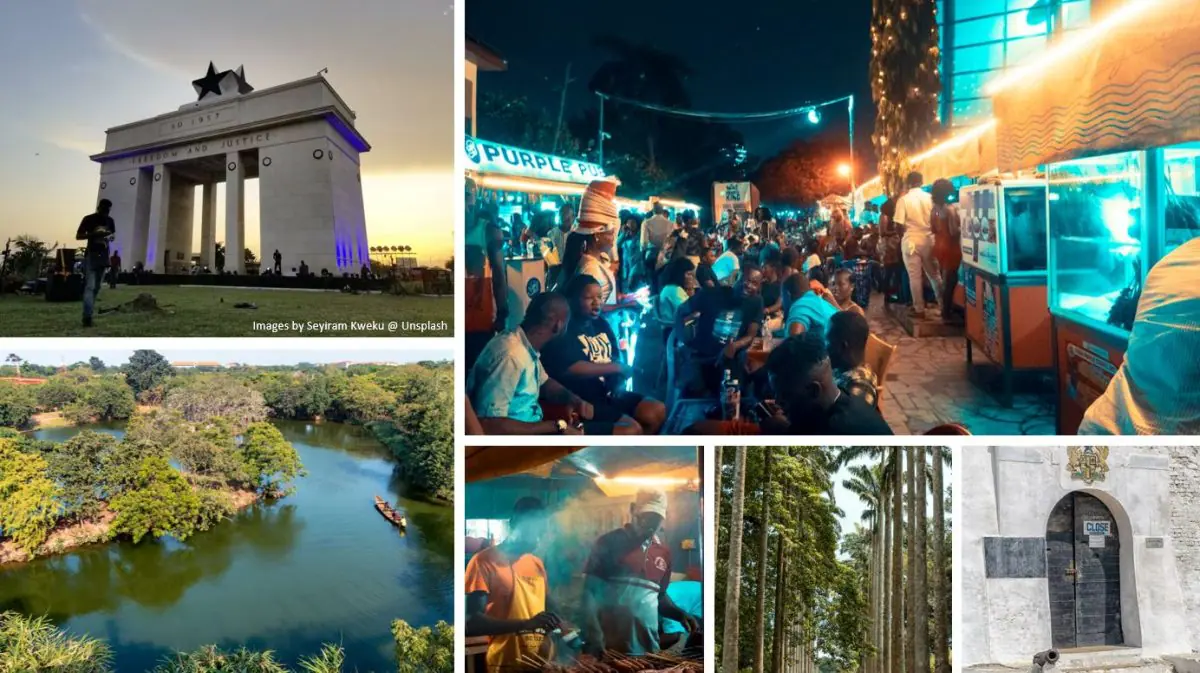
Cape Coast Castle and Elmina Castle (Central Region): These UNESCO World Heritage Sites are the most powerful and poignant remnants of the Transatlantic Slave Trade. A guided tour is an absolute must.
Kwame Nkrumah Memorial Park & Mausoleum (Accra): A tribute to Ghana’s first President, an essential site for understanding modern Ghanaian history.
Manhyia Palace Museum (Kumasi, Ashanti Region): Dive into the history of the powerful Ashanti Kingdom and its enduring culture.
Kakum National Park (Central Region): Famous for its thrilling Canopy Walkway high above the forest floor.
Mole National Park (Savannah Region): Ghana’s largest wildlife reserve. The best place for a walking safari to see elephants, antelopes, and various bird species up close.
Wli Waterfalls (Volta Region): The tallest waterfall in West Africa.
Busua Beach (Western Region): Known for its laid-back atmosphere, golden sands, and excellent beginner surfing conditions.
Ada Foah (Greater Accra Region): Where the Volta River meets the Atlantic Ocean—a hub for water sports and beautiful resorts.
Luxury: Look at areas like Airport Residential in Accra, or unique coastal escapes like Lou Moon Lodge. – Not this is in Axim not Accra.
Mid-Range: Boutique hotels and reliable Airbnbs in East Legon or Labone offer comfort and local flavor.
Budget/Hostels: Concentrated around tourist hubs in Accra and Cape Coast—the best way to meet fellow travelers.
Jollof Rice: The dish that sparks continental debate. There is only one version here – and its Ghana made —it’s the best!
Fufu & Soup: A spongy, pounded cassava/plantain dough served with a rich, flavorful soup. An essential cultural experience.
Kelewele: Deep-fried plantain cubes seasoned with ginger, chili, and spices. The ultimate street snack.
To experience the ultimate cultural richness, try to align your trip with a major festival.
| Festival | Region/People | Typical Month(s) | Focus |
| Aboakyer | Winneba (Efutu) | May (1st Sat) | Deer Hunting Festival (commemorating migration) |
| Homowo | Ga (Greater Accra) | August/September | Harvest Festival (“Hooting at Hunger”) |
| Fetu Afahye | Cape Coast (Oguaa) | September (1st Sat) | Purification Festival (remembrance of a historic disease) |
| Hogbetsotso | Anlo (Volta Region) | October/November | Exodus Festival (commemorating migration from Notsie) |
| Adae Kese | Ashanti (Kumasi) | Every 6 Weeks (Special Grand Durbar) | Royal Festival (honoring ancestors and the Ashanti King) |
Discover amazing discounts on things to do in Ghana
 Accra
26°C
Accra
26°C