
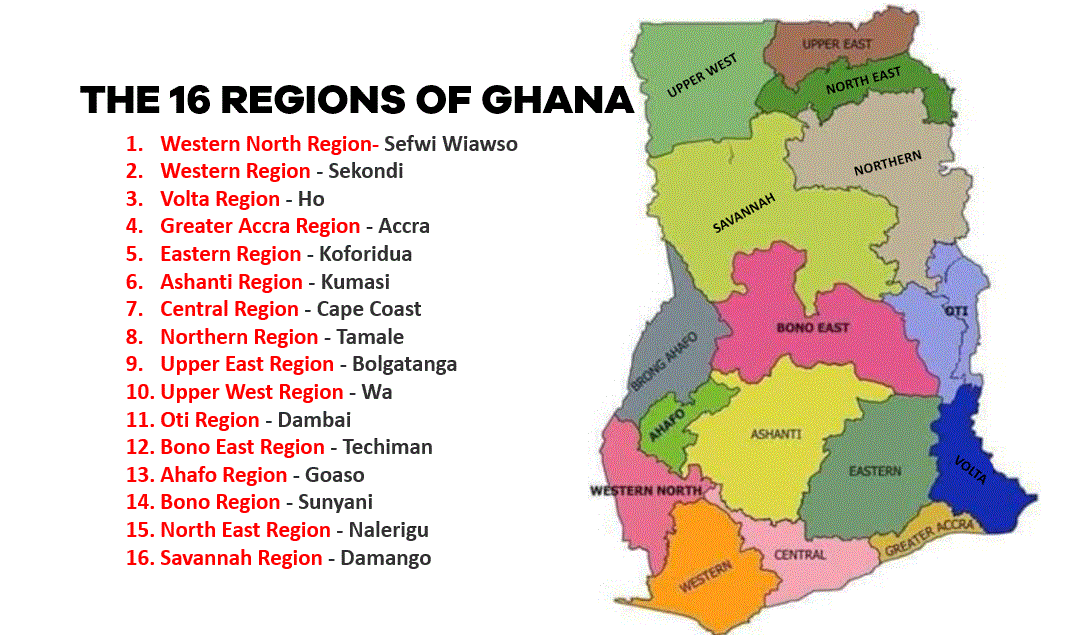
Ghana has 16 administrative regions, each with its own regional capital. Until 2018, Ghana had 10 regions, before six new regions were created following referendums held in December 2018.
Use the interactive map below to explore Ghana’s 16 regions, see where each region is located, find its regional capital and discover more about the area.
Explore Ghana’s 16 regions
Select a region on the map to see its capital, a quick introduction and a link to the viewGhana regional guide.
Loading interactive map…
Select a region
Click or tap any named region on the map to explore it.
Explore Ghana’s 16 regions
Select a region on the map to see its capital, a quick introduction and a link to the viewGhana regional guide.
Why does Ghana have 16 regions?
Until 2018, Ghana was divided into 10 administrative regions. Following decades of petitions from communities seeking greater local representation, referendums were held to create six additional regions.
The changes were intended to bring administration and development closer to communities, particularly in areas located a long distance from their existing regional capitals.
The six new regions brought Ghana’s total from 10 to 16 administrative regions.
Which six new regions were created in Ghana?
Four existing regions were divided to create the six new regions:
- Western Region → Western and Western North
- Northern Region → Northern, North East and Savannah
- Volta Region → Volta and Oti
- Brong-Ahafo Region → Bono, Ahafo and Bono East
The new regions became official following the 2018 Ghanaian New Regions Referendum, held on 27 December 2018.
Why were the six new regions created?
The main aim was to bring government and public administration closer to local communities.
Some communities had campaigned for their own regions for decades. The campaign for what became the Oti Region, for example, can be traced back to the 1950s.
Creating smaller administrative regions was intended to support:
- Better local administration – reducing the distance between communities and regional authorities.
- Decentralisation – allowing decisions and services to be managed closer to local populations.
- Regional development – helping infrastructure and public investment respond more directly to local needs.
Explore Ghana’s 16 regions
Ghana’s regions are also a useful way to explore the country. From Accra in Greater Accra and Kumasi in Ashanti to Cape Coast in Central Region and Tamale in Northern Region, each part of Ghana offers different places, cultures and experiences.
Explore attractions, places to visit, events and travel ideas from across Ghana’s 16 regions.
Discover more things to experience within the 16 regions of Ghana
Find out more about specific sites and locations in Ghana
Boti Falls
Boti Falls, Boti, Eastern Region, Koforidua, Ghana
Boti Falls is one of the most popular natural attractions in Ghana and a must-see…
Mole National Park
Mole National Park, off the Damongo-Sawla road, Northen Region, Larabanga, Ghana
If you want to experience the savannah of Ghana with safari with all its wildlife…
Larabanga Mosque
Larabanga Mosque, Sawla-Damongo Rd, Northern Region, Sawla, Ghana
The Larabanga Mosque is shrouded in many stories and legends. As the legend goes, Ayuba,…
Bia National Park
Bia National Park, Adwuofua, Western North Region, Adwuofua, Ghana
The Bia National Park covers a total area of 305.62km² and is located in the…


As someone planning a research trip from Singapore, this breakdown is incredibly helpful. It’s interesting to see how the geography changes as you move north. Is there a specific region known best for traditional textiles?”
This is a great refresher. Most people focus on Greater Accra and Ashanti, but the Oti and North East regions have some hidden gems for tourism that we don’t talk about enough. Which region is currently the most popular for weekend trips away from the city?”